The Innocence of Not Knowing: Grief is What Makes Hope Honest
One of the things I don’t think people talk about enough after psychosis, a diagnosis, hospitalisation, or being sectioned is grief.
Not just the obvious grief. Not just the grief of what happened.
But the grief of who you were before it happened.
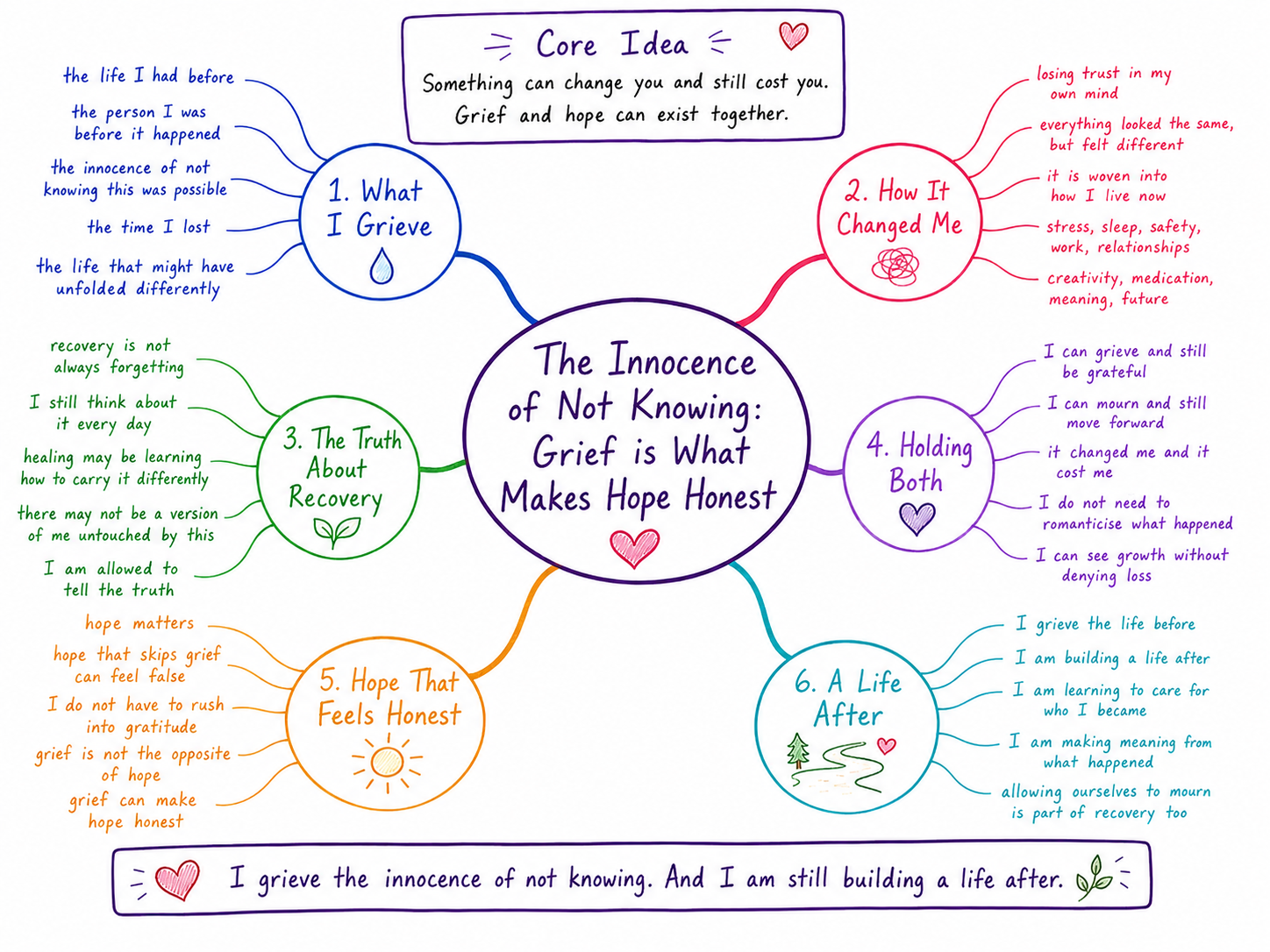
I grieve the life I had before. The version of me who didn’t know this was possible. The person who moved through the world without the knowledge that my mind could turn on me so completely. The person who had not yet been sectioned. The person who had not yet sat in a psychiatric hospital trying to understand how life had changed so suddenly.
There is a kind of innocence in not knowing.
Before it happened to me, psychosis was something I’d only heard of vaguely. Mental illness was something I knew existed. Crisis was something that happened to people. But I did not know, in my body, what it felt like for reality itself to become unsafe. I did not know what it felt like to lose trust in my own mind. I did not know what it felt like to come home afterwards and realise that nothing looked obviously different, but everything felt changed.
And I grieve that innocence.
I think there can be an assumption that, after enough time has passed, you should be able to “forget about it and move on”.
But I don’t think I have forgotten about it.
I think about it every day.
Not always dramatically. Not always painfully. Not always in a way that ruins the day. But it is there. Woven into how I understand myself now. Woven into how I think about stress, sleep, safety, work, relationships, creativity, medication, meaning, and the future.
It is not something I can simply cut out of my life story.
It happened to me. It changed me. It lives in the way I move through the world now.
And I think part of the grief is accepting that there may not be a version of recovery where I never think about it again. Maybe recovery is not forgetting. Maybe recovery is learning how to carry it differently.
I grieve the time I lost, too. The months and years that were shaped by recovery, fear, medication, exhaustion, shame, appointments, rebuilding, explaining, not explaining, trying to seem okay, trying to become okay. I grieve the version of my life that might have unfolded if none of this had happened.
That does not mean I hate my life now.
It does not mean I am not grateful to be here.
It does not mean I cannot see the growth, the meaning, the compassion, the creativity, and the self-knowledge that came afterwards.
It just means I am allowed to tell the truth.
Something can change you and still cost you. Something can make you deeper and still be something you wish you had never had to survive.
I think sometimes recovery spaces can rush us towards hope. And hope matters. It really does. But hope that skips grief can feel false. It can feel like being asked to be grateful too quickly. To turn pain into purpose before we have even admitted what was lost.
I do not want to romanticise what happened to me. I do not want to pretend it was all beautiful or necessary or “meant to be”. I also do not want to deny that it changed me in ways that now feel important.
So I hold both.
I grieve the life before. And I am building a life after.
I grieve the person I felt I was. And I am learning to care for the person I became.
I grieve the innocence of not knowing this could happen. And I am trying to make meaning from knowing that it did.
Maybe that is part of recovery too. Not just moving forward. Not just staying well. Not just making plans and learning warning signs and rebuilding routines…
But allowing ourselves to mourn.
Because grief is not the opposite of hope.
Sometimes grief is what makes hope honest.