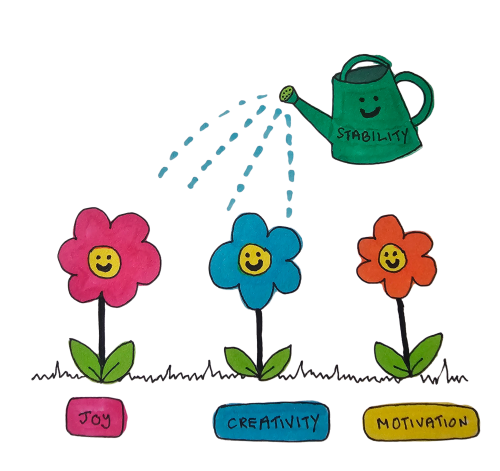
Learning To Trust Good Moods Again
What it feels like to rebuild joy, motivation and creativity after mania
After my second hospitalisation, I didn’t bounce back. I fell into a depression, which is common for people who have experienced episodes of mania.
I wasn’t motivated. I wasn’t doing much. I didn’t feel like myself. At the time, I think part of me wondered if this was just what stability was supposed to look like now: quieter, flatter, less alive.
But then we changed my medication.
I switched to something less sedating, and gradually I got my motivation and drive back. I started doing things again. I picked up hobbies. I got into embroidery and cross-stitch. I returned to paint-by-numbers, which was something I had discovered after my first hospitalisation. I had more energy, more curiosity, more interest in life.
And then… my psychiatrist became concerned.
I understand why. My diagnosis was still new to me, and I didn’t know as much then as I do now. I had recently been hospitalised after a manic episode, and suddenly I was starting new hobbies quite quickly. From the outside, that could have looked like a warning sign.
At first, I felt scrutinised. I felt watched. I worried that my happiness, creativity and motivation were being treated as suspicious.
I don’t blame people for worrying. After mania, concern can be love. But being constantly monitored can also make you feel like your personality is on trial.
Ultimately, I was grateful they were being careful.
Because with bipolar disorder, learning to trust good moods again can be complicated.
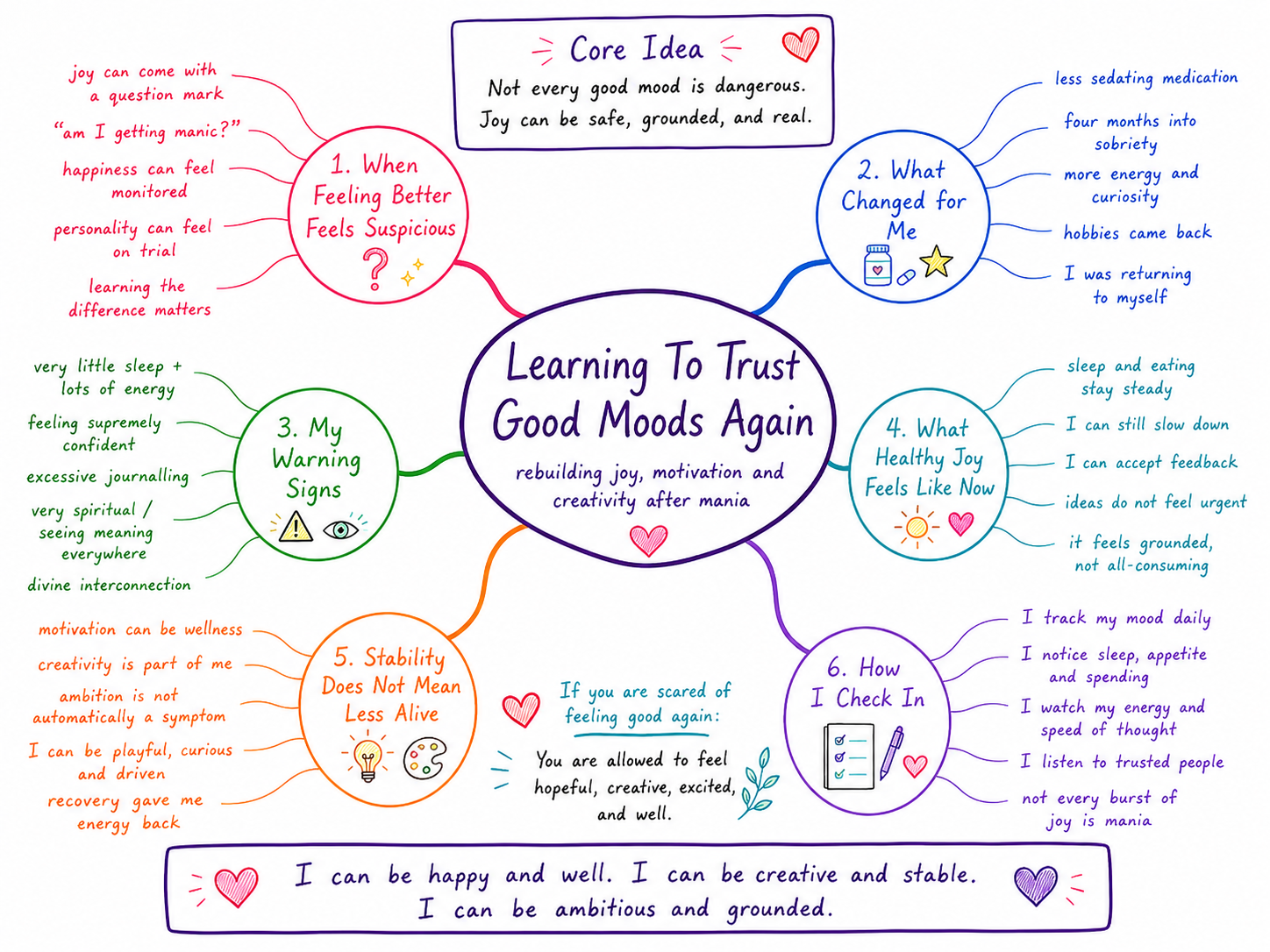
When feeling better feels suspicious
After mania, joy can start to feel like something you have to monitor.
Happiness, confidence, creativity, motivation, spirituality, excitement, ambition, connection, hope… all the things that should feel good can suddenly come with a question mark.
Am I getting manic?
Is this too much?
Can I trust this?
Will people think I’m unwell?
Am I allowed to be excited about my life?
That is a strange thing to live with. Because recovery is supposed to involve feeling better. But when feeling “too good” has previously been part of becoming unwell, it makes sense that your brain, your loved ones, and your care team might become cautious.
For me, the challenge was learning the difference between coming back to life and becoming unwell again.
Medication, sobriety and getting myself back
When I became more active again, it wasn’t happening in isolation.
My medication had changed, and I was four months into sobriety.
I had more free time. I had more clarity. I had more evenings and weekends that were not shaped by drinking. I had more space to be curious, creative and present.
So yes, I had suddenly picked up more hobbies. But my previous state of inactivity had been partly down to medication, not me.
And yes, I hadn’t always had quite so many hobbies before. But I was also in a completely different stage of my life. I was sober. I was recovering. I was rebuilding. I was discovering what I actually enjoyed.
That distinction mattered to me.
Because I wasn’t trying to become someone new in a manic way. I was trying to return to myself, and maybe meet a fuller version of myself at the same time.
My warning signs
Even though I believed this new energy was healthy, I still had to pay attention.
I checked for my early warning signs. For me, they include feeling extremely energised on very little sleep, feeling supremely confident, wanting to journal an excessive amount, feeling very spiritual, seeing meaning everywhere, and feeling a sense of divine interconnection in my life.
Those things did not creep in, thankfully.
My sleep stayed stable. My eating stayed stable. My basic routines stayed intact. I was not racing away from myself. I was still able to pause, reflect, listen and take care of myself.
That helped me trust that what I was experiencing was not mania.
It was activation, but it was healthy activation.
It was my personality coming back.
What healthy joy feels like now
A healthy good mood, for me, happens when the basics are still in place.
I am eating well. I am sleeping well. I am taking care of myself. I can still listen to people. I can still slow down. I can still recognise when I need rest. I can still accept feedback. I can still tell the difference between an idea and an emergency.
That’s different from mania.
Mania, for me, has a force to it. It gathers speed. It feels bigger than me. It can become spiritual, intense, urgent and all-consuming.
A healthy good mood feels more grounded.
It can still be joyful. It can still be creative. It can still be ambitious. It can still be full of ideas.
But it does not require me to abandon the basics.
Stability does not mean becoming less alive
I wish people understood that joy after a bipolar diagnosis can be complicated.
Feeling motivated, creative, confident or excited does not automatically mean I am becoming manic. Sometimes it means I am well. Sometimes it means my medication is working better. Sometimes it means I have more time, more stability, more self-awareness, and more room to be myself.
Stability does not have to mean becoming flat, quiet, sedated, or less alive.
For me, recovery has involved getting my energy, creativity and personality back - not losing them.
I am naturally creative, curious, enthusiastic, playful, driven and full of ideas when I am well. I like starting projects, especially projects that create connection and community. I am entrepreneurial and ambitious. Those parts of me are not automatically symptoms.
They are part of who I am.
The work is learning how to hold those parts of myself with care.
How I check in with myself
Now, I try to enjoy feeling good while staying honest with myself.
I track my mood daily. I pay attention to my sleep, my appetite, my spending, my journalling, my energy levels, my speed of thought, and whether I can still pause. I listen to people I trust. I keep my routines in place. I remind myself that not every good mood is dangerous.
That last part is important.
Not every burst of joy is mania.
Not every new hobby is a warning sign.
Not every creative idea is a problem.
Not every moment of confidence needs to be feared.
Sometimes feeling good is just feeling good.
If you are scared of feeling good again
If you have bipolar disorder and you are scared of feeling good again, I understand.
It can feel frightening when your own happiness starts to feel like something you need to investigate. It can feel unfair to have to monitor joy. It can feel exhausting to wonder whether you are well or whether something is beginning.
But you are allowed to feel good.
You are allowed to feel hopeful. You are allowed to feel creative. You are allowed to feel excited about your life. You are allowed to have ambition, personality, humour, spirituality, connection and joy.
The goal is not to become less yourself.
The goal is to know yourself more clearly.
For me, learning to trust good moods again has not meant ignoring the risks. It has meant learning my warning signs, taking my wellbeing seriously, accepting support, and slowly proving to myself that joy can be safe.
I can be happy and well.
I can be creative and stable.
I can be ambitious and grounded.
I can come back to life without losing myself again.