Seeing Bipolar Disorder Type 1 Written in Black and White
How I moved from fear and disbelief towards understanding, self-trust, and acceptance.
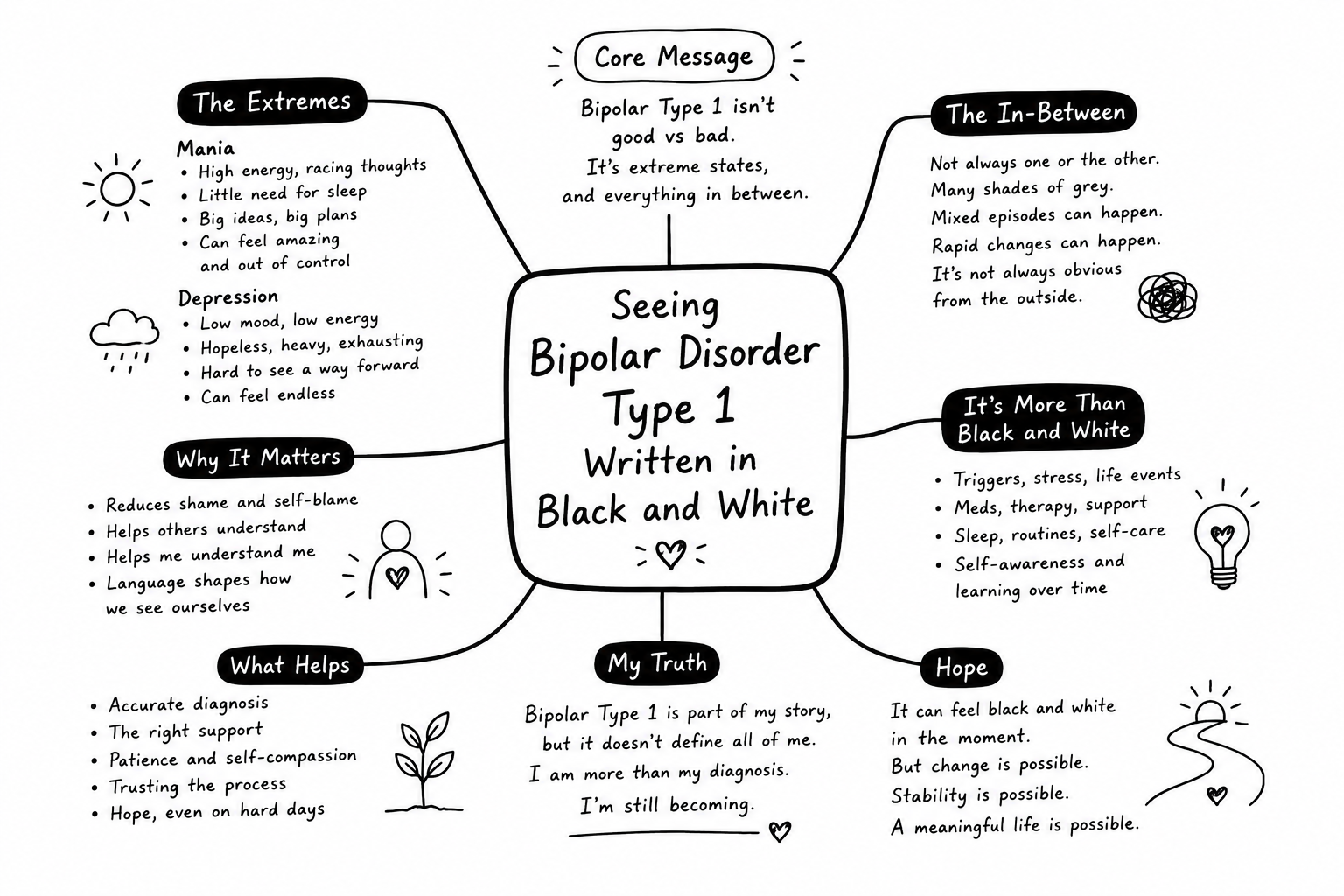
I was diagnosed with bipolar disorder type 1 during my second psychiatric hospitalisation in January 2023.
I say “diagnosed,” but the truth is, I don’t really remember being diagnosed.
It must have been explained to me in hospital at some point, but I have no recollection of that conversation. The only thing I remember clearly is seeing the words written on my discharge letter.
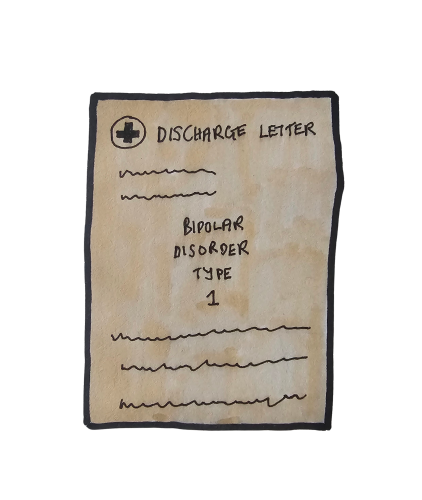
Bipolar disorder type 1.
In black and white.
I remember feeling confused. Scared. Disbelieving.
It didn’t feel like a moment of clarity. It didn’t feel like, Oh, finally, this explains everything.
It felt like a heavy label had been placed on me while I was still trying to understand what had happened.
At the time, I thought bipolar disorder meant mood swings from hour to hour. I didn’t understand what bipolar disorder type 1 really meant. I didn’t understand mania properly. I didn’t understand how serious it could be. I didn’t understand that, for me, it could involve psychosis, hospitalisation, and the complete rupture of my sense of reality.
I also had assumptions about bipolar disorder that I’m ashamed to admit now.
Before being diagnosed, I associated bipolar disorder with being “crazy.” It wasn’t politically correct. It wasn’t kind. It wasn’t informed. But it was there, absorbed from culture, language, stereotypes, and the way people talk about mental illness when they think it has nothing to do with them.
And then suddenly, the label was mine.
That was confronting.
I wish people understood how much stigma gets absorbed before you ever receive the diagnosis yourself. I had my own ideas about bipolar disorder, and then suddenly the label belonged to me. It made me realise how easily we turn people into stereotypes until we become one of the people we used to misunderstand.
I resisted the diagnosis for a long time.
Partly because I didn’t want to be seen as “crazy” myself. But there was also a horrible contradiction in that, because I had been sectioned. Twice. I had experienced psychosis. I had been hospitalised. I couldn’t pretend it was abstract anymore.
Still, the diagnosis didn’t feel like it belonged to me straight away.
It took me over a year to accept it for myself.
Part of what made it difficult was that I didn’t relate to a lot of the bipolar stories I was discovering in books and podcasts. For many people, bipolar disorder seemed to be woven through their childhood, teenage years, or young adulthood. But that wasn’t my experience.
I had not had a manic episode before my psychotic episode in 2020.
Mania was not part of my childhood story. It was not part of my teenage years. It was not part of my young adult life.
And that mattered to me.
Because when you are given a diagnosis, especially one that feels so huge, there can be this pressure to reinterpret your entire life through it. But for me, it didn’t explain everything. Not at first. Not neatly. Not in a way that made immediate sense.
The understanding came later.
At some point, I mapped out my manic, psychotic, and depressive episodes on a timeline. I wanted to see it outside of myself. I wanted to understand whether there really was a pattern.
And there was.
The timeline showed me that after periods of psychosis and mania, I had periods of depression. It also reminded me that I had been depressed when I was 13 or 14, after my best friend died. I hadn’t shared my grief journey with anyone. I was very alone in that for a long time.
Seeing the pattern was illuminating.
It didn’t mean the diagnosis suddenly became easy, but it became harder to ignore. I could see that mania had not just been an abstract state of feeling “up” or “energetic.” It had had severe consequences. I had been hospitalised.
That changed how I understood the word “extreme.”
Before, I thought bipolar meant extreme mood swings. Now I understood that, in my life, “extreme” meant something much more serious. It meant losing touch with reality. It meant being sectioned. It meant the aftermath. It meant trying to rebuild a life after something frightening had happened.
That realisation was helpful, but it was also frightening.
At the time, I was scared of relapse. I was scared of when it might happen again. I was scared of my own mind and whether I could trust myself.
The diagnosis changed how I saw myself. I can’t fully explain how, but it made me question everything I thought I knew about who I was. The feeling of needing to rebuild trust in myself resurfaced, and it felt like my recovery had gone 100 steps backwards.
That was really disheartening, because I thought I had already made so much progress since 2020.
And then suddenly, there was another layer.
Another hospitalisation. Another explanation. Another label. Another version of myself to understand.
For two years, I kept the diagnosis very private. My family knew, and I told only very close friends. No one reacted badly. They just wanted to understand more. But I wasn’t ready to be public about it.
I think shame played a big part in that.
Shame around the diagnosis. Shame around the hospitalisation. Shame around the psychosis and mania. Shame that came from believing I should have known better.
But how could I have known better about something I didn’t understand yet?
That’s one of the things I see differently now.
Recovery has not just been about accepting a diagnosis. It has been about forgiving myself for being ill. It has been about understanding that needing help is not a personal failure. It has been about learning that self-trust does not mean blindly trusting every thought, feeling, impulse, or surge of energy.
Sometimes self-trust means knowing when to pause.
Sometimes it means telling someone, “I think something might be changing.”
Sometimes it means going to bed instead of following every thought.
Sometimes it means noticing that confidence has tipped into something too intense.
Sometimes it means letting other people help me hold the reality of my life when my own mind starts making too much meaning out of everything.
I know some of my early warning signs now.
Feeling extremely energised on very little sleep. Feeling supremely confident. Wanting to journal an excessive amount. Feeling intensely spiritual. Feeling like meaning is everywhere. Feeling a sense of divine interconnection in my life.
These things are complicated because, in ordinary amounts, some of them can be beautiful. I am a reflective person. I am creative. I am spiritual. I like meaning. I like noticing patterns. I like feeling connected to life.
But I have had to learn the difference between meaning and too much meaning.
Between confidence and dangerous confidence.
Between creativity and acceleration.
Between feeling alive and becoming unwell.
That is part of how I rebuild trust in myself now. Not by rejecting every intense feeling, but by understanding my own patterns with more honesty and care.
It has been gradual.
Witnessing other people with bipolar disorder living fruitful, joyful lives has helped. Making friends with people with bipolar whom I admire has helped. Consuming media by people who have been through similar things and come out the other side has helped. Peer support groups, including Bipolar UK groups in London, have helped. Therapy, information, medication, community, creativity, time, and the support of people who love me have all helped.
I don’t think acceptance was one single moment.
It was more like slowly putting down the fight.
Accepting the diagnosis does not mean I like it. It does not mean I wanted it. It does not mean it explains every part of me.
It means I understand it enough to take it seriously.
It means I can see the pattern now.
It means I know there are things I need to protect: my sleep, my stability, my support network, my self-awareness, my future.
It means I am not trying to outrun the truth anymore.
This year, in 2026, I have started speaking about it more publicly.
Part of that is because it has been three years since my last hospitalisation. But more than that, I feel like I have evolved into the person I need to be now.
I feel stronger in my power, self-trust, and self-belief.
Not in a manic way, lol.
In a grounded way.
I am backed by a lot of support from my family, my friends, and my work. I feel freer to be my authentic self. And because of that, I want to help other people too.
Because I know what it is like to see those words written down and feel terrified.
I know what it is like to think, What does this mean for my future? What does this mean for work, relationships, independence, identity, relapse, medication, and how people see me?
I know what it is like to feel like a diagnosis is an ending.
But I don’t think it has to be.
If you have just seen “bipolar disorder type 1” written on a discharge letter and you feel scared, I want you to know that I understand.
It is a heavy thing to read, especially if no one has properly sat with you and explained what it means.
You do not have to accept it all at once.
You do not have to understand your whole life overnight.
You are allowed to feel scared, confused, angry, ashamed, numb, or disbelieving.
A diagnosis can feel like an ending, but over time, it can also become a tool. Not immediately. Maybe not for a long time. But slowly, it can help you understand your patterns, your risks, your needs, and the support that helps you stay well.
You are not a stereotype.
You are not just a diagnosis.
You are still a whole person.
And even if you do not fully trust yourself right now, that trust can be rebuilt.