Psychosis and the Dark Night of the Soul
I do think I had to go through psychosis to become who I am today.
But I wish I didn’t have to.
I wish there had been an easier way to learn the things I’ve learned. I wish my life didn’t have to be interrupted so violently. I wish my career, relationships, confidence, sense of self and trust in my own mind hadn’t been shaken in the way they were.
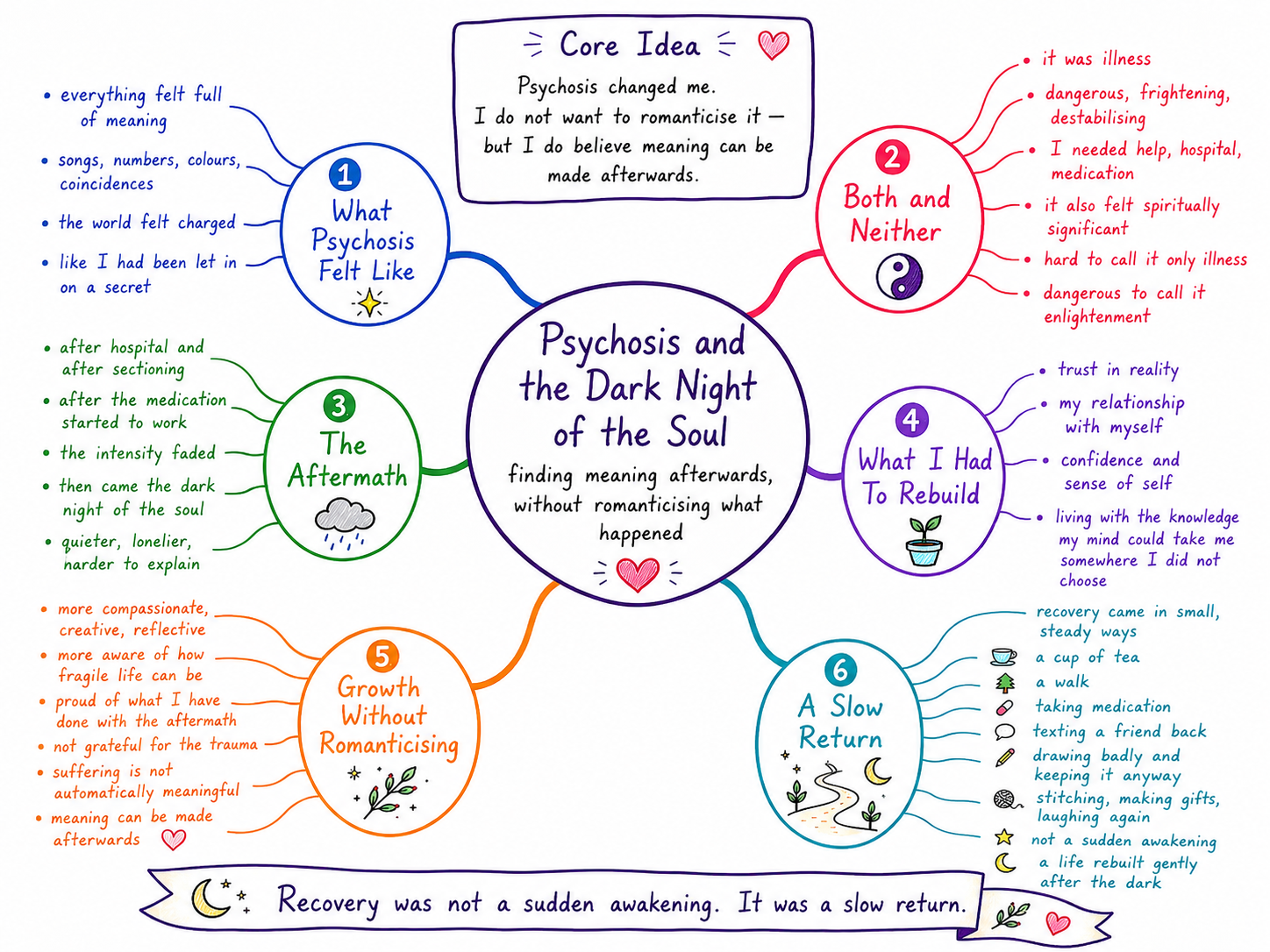
Psychosis changed me. I can’t honestly say it didn’t.
At the time, everything felt full of meaning. Songs, numbers, conversations, colours, coincidences, car registration plates - all of it seemed connected to me somehow. The world felt charged with significance, as though I had been let in on a secret.
Looking back, I don’t know how to describe it neatly.
It was illness, yes. It was dangerous, frightening and destabilising. I needed help, hospital, and I needed medication.
But it also felt spiritually significant. It felt like something had cracked open in me. It changed the way I saw myself, the world, meaning, suffering, love, fear and survival.
So I find it hard to call it only illness.
And I find it dangerous to call it enlightenment.
It was both and neither at the same time.
And then came the aftermath.
After hospital. After being sectioned. After the medication started to work. After the intensity faded. That was when I entered what I can only describe as a dark night of the soul.
Not because it was beautiful or poetic. But because I had to sit in the dark with everything I had lost, everything I had believed, everything I had done, and everything I no longer understood about myself.
The crisis itself was terrifying. But the existential crisis after the crisis was quieter, lonelier, and in some ways harder to explain.
I had to rebuild my trust in reality. I had to rebuild my relationship with myself. I had to learn how to live with the knowledge that my own mind could take me somewhere I didn’t choose to go.
In some ways, psychosis made me more compassionate, more creative, more reflective, and more aware of how fragile life can be. It forced me to rebuild myself from somewhere very low.
But that doesn’t mean I’m grateful for the trauma.
It means I’m proud of what I’ve done with the aftermath.
I don’t want to romanticise psychosis. I don’t believe suffering is automatically meaningful. And I don’t think people need to be broken open in order to grow.
But I do believe that meaning can be made afterwards.
Slowly, carefully, honestly.
Not in the grand, cosmic way I thought I had found during psychosis, but in smaller, steadier ways. In making a cup of tea. In going for a walk. In taking medication. In texting a friend back. In drawing something badly and keeping it anyway. In stitching something by hand. In making gifts. In laughing again.
Maybe that is what recovery has been for me.
Not a sudden awakening.
But a slow return.
A life rebuilt gently, after the dark.