Recovery Looked Like Tiny Things
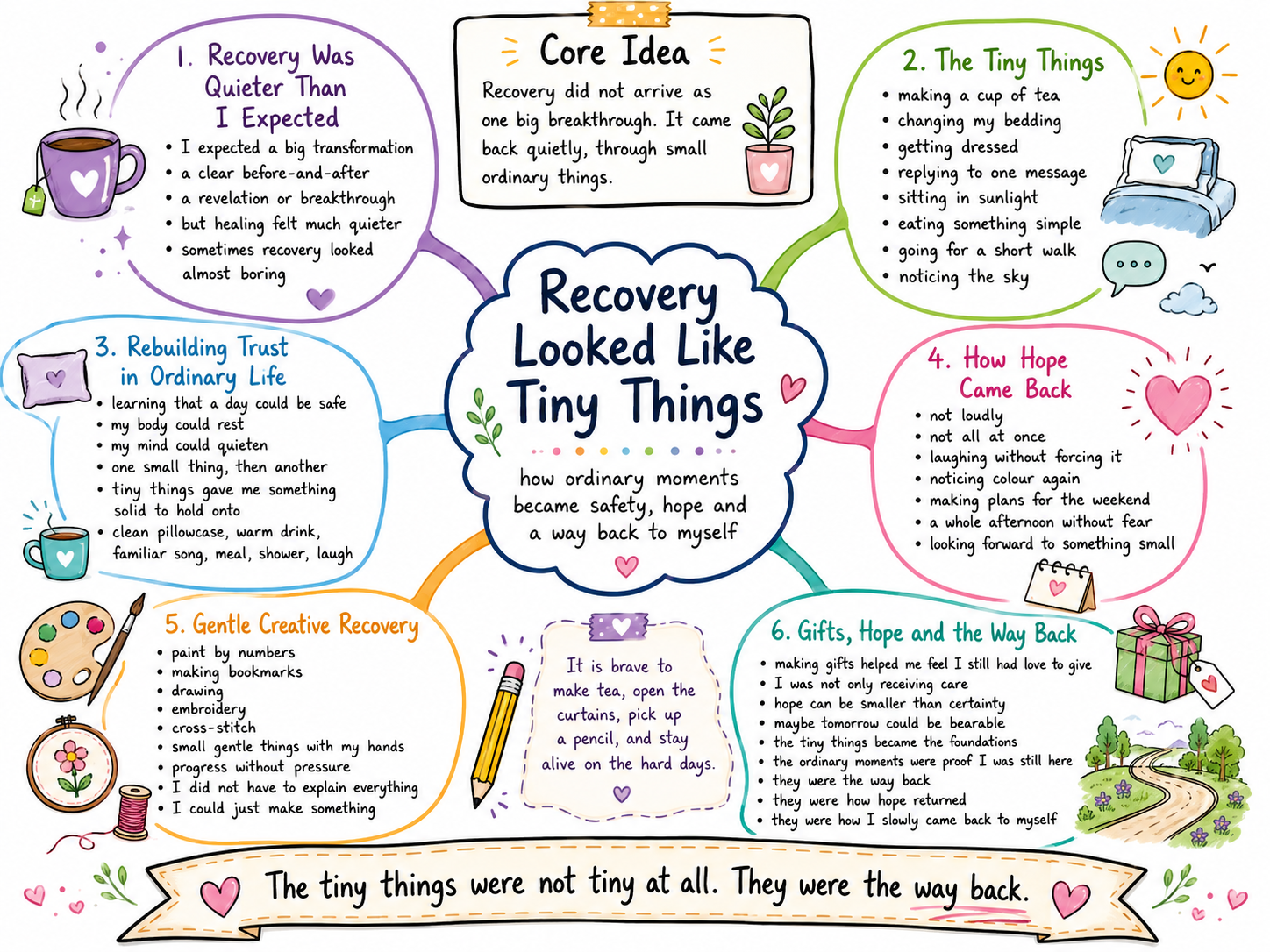
I think, for a long time, I expected recovery to feel bigger than it did.
After something as huge as psychosis, hospital, and being sectioned, I think part of me expected healing to arrive as a grand moment of transformation. A breakthrough. A revelation. A clear before-and-after where I would suddenly feel like myself again.
But recovery was much quieter than that.
Sometimes recovery looked almost boring. It looked like making a cup of tea. It looked like changing my bedding. It looked like getting dressed, even if I had nowhere important to go. It looked like replying to one message. It looked like sitting in sunlight. It looked like eating something simple. It looked like going for a short walk and noticing the sky.
At the time, those things did not always feel impressive. They did not feel like the kind of recovery story people write about. They were not dramatic or inspirational or neatly packaged. But looking back, I think they mattered more than I realised.
Because after psychosis, I did not just need to rebuild my life in big ways. I needed to rebuild trust in ordinary life. I needed to learn that a day could be safe. That my body could rest. That my mind could quieten. That I could do one small thing, and then another, and then another.
The tiny things helped me come back because they gave me something solid to hold onto. A clean pillowcase. A warm drink. A familiar song. A message from a friend. A meal. A shower. A laugh. These things did not fix everything, but they helped me live through the days while I was still trying to understand what had happened to me.
I think hope came back in the same way.
Not loudly. Not all at once. Not as a huge life-changing realisation. Hope came back quietly, in moments I almost missed. It came back when I laughed without forcing it. It came back when I noticed colour again. It came back when I made plans for the weekend. It came back when I realised I had gone a whole afternoon without feeling afraid. It came back when I looked forward to something small.
And somewhere in that quiet rebuilding, I started discovering hobbies I loved.
Paint by numbers. Making bookmarks. Drawing. Embroidery. Cross-stitch. Small, gentle things I could do with my hands when my mind felt tired. Creative things that did not ask too much of me. Things where I did not have to be impressive or productive or “back to normal.” I could just sit down, choose a colour, make a stitch, draw a line, finish one tiny section at a time.
There was something very healing about making things. It gave me somewhere to put my attention. It gave me a sense of progress without pressure. It helped me feel connected to myself again in a way that was quiet and practical. I did not have to explain everything I was feeling. I could just make something.
And then I started making gifts for my friends and family.
That became its own kind of hope.
A bookmark. A drawing. A stitched piece. Something small and handmade that said, “I love you. I thought of you. I made this with my own hands.” I think that mattered because recovery can sometimes make you feel like you are only receiving care. But making gifts helped me feel like I still had love to give. I was not just someone being looked after. I was someone who could create, contribute, notice people, and offer something back.
I used to think hope had to feel certain. Like you had to know everything was going to be okay before you could believe in the future. But I do not think that anymore. I think sometimes hope is much smaller than certainty. Sometimes hope is just the tiniest feeling that maybe tomorrow could be bearable. Maybe next week could be softer. Maybe life could slowly become good again.
And slowly, it did.
Not perfectly. Not quickly. Not in a straight line. But over time, the tiny things became the foundations of something bigger. The ordinary moments became proof that I was still here. The boring routines became a kind of safety. The cups of tea, the clean sheets, the walks, the messages, the sunlight, the drawings, the stitches, the little handmade gifts — they all helped me build a life I could return to.
And then, eventually, a life I could love.
I think there is humility in that kind of recovery. It does not announce itself loudly. It does not always look brave from the outside. But it is brave. It is brave to keep making tea, to get washed, to open the curtains. It is brave to pick up a pencil or a needle or a paintbrush when you are not sure who you are anymore. It is brave to make something small. It is brave to let someone love you when you feel like a burden. It is brave to stay alive on the days when staying alive is the whole task.
Looking back, I can see that the tiny things were not tiny at all.
They were the way back.
They were how hope returned.
They were how I slowly came back to myself.