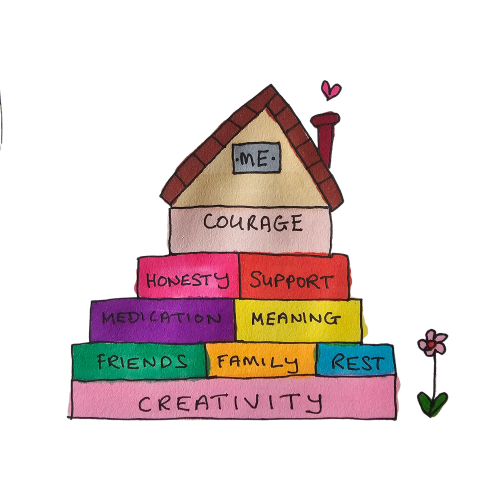
I Am Here: Rebuilding Self-Trust After Psychosis, Hospital, and the Crisis after the Crisis
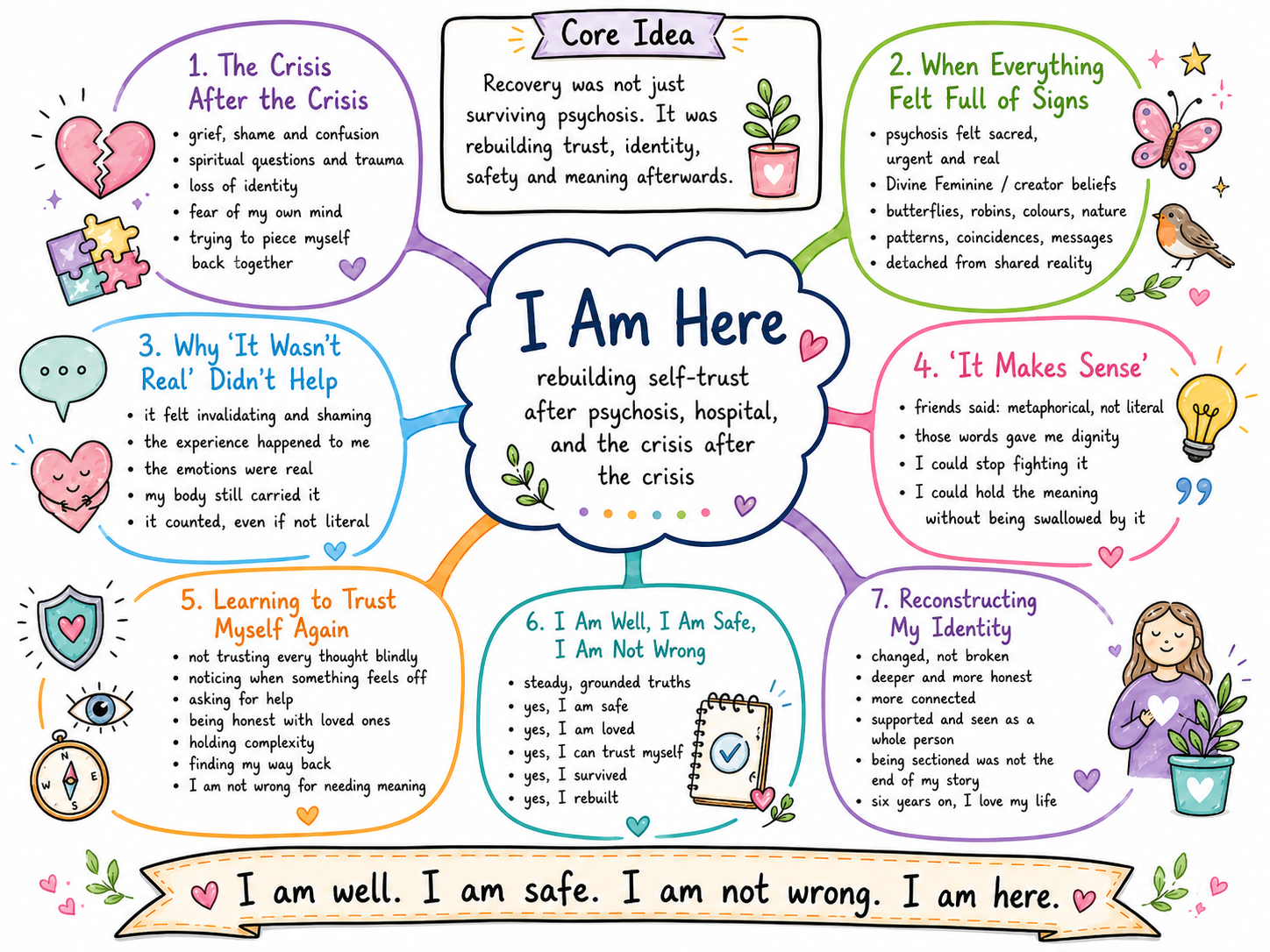
Content note: This post discusses psychosis, delusional beliefs, hospitalisation, trauma, fear of death, and moments of not wanting to be alive. I am writing from a place of recovery, reflection, and safety.
Six years after my psychotic break, I can say something I was not always sure I would ever be able to say:
I am here.
I want to be here.
And I love my life.
That feels very simple written down, but it has taken years to get here. It has taken years of reconstructing my identity, rebuilding my self-trust, learning to feel safe in my own mind again, and slowly making meaning from experiences that were once too frightening, too confusing, too beautiful, too shameful, too painful, and too enormous to hold.
I think sometimes people imagine recovery from psychosis as a fairly neat timeline. You become unwell. You go into hospital. You are discharged. You take medication. You are better.
But for me, the real work began afterwards.
Hospital was one part of the story. Being sectioned was one part of the story. The psychosis itself was one part of the story. But after that came the question I did not know how to answer:
Who am I now?
Who am I after my mind has taken me somewhere so far away from shared reality?
Who am I after I have believed things with my whole body, heart and soul, only to be told afterwards that they were symptoms?
Who am I after I have touched something that felt like divine love and absolute terror at the same time?
I think that is the part people do not talk about enough: the crisis after the crisis. The existential life crisis that can come after psychosis. The grief, the shame, the confusion, the spiritual questions, the trauma, the loss of identity, the fear of your own mind, and the strange, lonely task of trying to piece yourself back together.
When everything felt full of signs
In 2020, I experienced psychosis. I was sectioned and spent time in a psychiatric hospital. At the time, my mind created a reality that was terrifying and beautiful and expansive and completely consuming.
I believed I was the Divine Feminine Goddess and creator of the entire universe. I was 33 at the time, and that felt deeply meaningful to me because Jesus was 33 when he was crucified and resurrected. I believed I was a female equivalent rising to restore balance in the world.
I believed I could communicate telepathically with spirits and dead loved ones through signs. Butterflies. Robins. Colours. Nature. Coincidences. Patterns. Messages hidden in ordinary things.
I did not hear voices. It was not like that for me. It was more of a knowing. A deep, bodily certainty. It felt like I was downloading messages from the universe, from nature, from love, from the spirit world. My whole body would tingle when I felt I was receiving something.
It felt sacred.
It felt urgent.
It felt completely real.
And I know now that I was detached from the reality that other people were living in. I know that. I understand that I was in psychosis. I understand that the beliefs I held were delusional in a clinical sense.
But I also think one of the hardest parts of recovery has been learning how to say this:
It felt real to me.
It happened to me.
And the impact of it was real.
Why “it wasn’t real” didn’t help me
For a long time, I felt like I was only allowed to recover if I rejected all of it. Like I had to draw a hard line through the whole experience and say, “None of that was real. I was just unwell.”
But that did not help me.
It made me feel ashamed, wrong, and like I had to invalidate the most intense experience of my life in order to be considered well.
I think that is a very difficult thing to ask of someone.
Because when psychosis happens, it does not feel like a thought you can just put down afterwards. It can go through your memories, your body, your relationships, your sense of self, your understanding of the world, your spirituality, your grief, your fears, your childhood, your family, your future.
It is not always something you can neatly separate from the rest of your life and say, “That part was not real, so it does not count.”
For me, it did count.
Not because every belief was literally true.
But because the experience was real in my body. The emotions, the terror, the love, the grief was all real. The meaning I was trying to make was real. The wounds it revealed were real.
And I think that distinction has been central to my healing.
The light was easier to talk about
In psychosis, I felt like I had touched both darkness and light. Fear and love. Death and resurrection. Rupture and connection. I felt like everything was symbolic. Everything meant something. Everything had an opposite. Everything was about balance.
I remember feeling love and connectedness and oneness in a way I had never felt before. I could feel the vibrations from leaves and flowers and the grass beneath my bare feet. I felt like colour had become alive. I felt like the world had suddenly burst open.
I felt like love was not just an emotion, but a state of consciousness.
Like love was everywhere.
And that part has always been easier to talk about.
The light, the love, the connection. The feeling that nature was speaking. The butterflies and robins and colours. The beautiful parts are more palatable, both for myself and for other people.
It is much easier to say, “Psychosis taught me about love and connection,” than it is to say, “Psychosis also left me with terror, shame, guilt, fear of death, and painful beliefs that took years to even look at.”
But both are true.
And I think part of recovery has been learning not to split the experience into a version other people can tolerate and a version I have to carry alone.
“It makes sense”
For a long time, there was one delusion that caused me the most hurt, guilt and shame. It took me two years before I could even allow myself to think about it properly.
The problem was not only the belief itself. It was the way it attached itself to memories and relationships. It felt like it had rippled backwards and forwards through my life. It felt like it had stained things. Like it had changed how I related to someone I loved. Like memories were suddenly covered in a feeling I could not unfeel.
And when people said, “It was not real. It was just a symptom of psychosis,” I know they were trying to help. I know they were trying to reassure me. I know they wanted me to be free from it.
But it did not free me.
It made me feel more alone.
Because for me, it had been real. Not necessarily literally real, but emotionally real. Real in the way a dream can be real. Real in the way trauma is real. Real in the way your body can hold something even after your logical mind understands it differently.
I think one of the most important moments in my recovery came not from a clinical explanation, but from a conversation with close friends.
I told them about the conflict I could not resolve. How could I accept the good parts as meaningful, but reject the painful parts as delusional? How could I accept the love and connection as somehow true, but put the fear and darkness away as “not real”?
And then I told them about the delusion that had caused me so much shame.
They did not tell me it was silly.
They did not tell me it was just psychosis.
They did not tell me to stop thinking about it.
They said something that lifted a weight I had been carrying deep in my heart.
They said it was real, but metaphorical.
Not literal.
Metaphorical.
And then they said:
“It makes sense.”
Those words changed something in me.
Not “it was true.”
Not “you were wrong.”
Not “forget about it.”
Not “that was just your illness.”
Just:
It makes sense.
I think those words gave me back some dignity. They allowed me to stop fighting the experience and start understanding it. They gave me a way to hold the delusion without being swallowed by it.
Not literally true, but not meaningless either
I think this is one of the most complicated parts of making meaning after psychosis. There is a fine balance.
Please don’t get me wrong: I absolutely do not want to romanticise psychosis. I do not want to pretend it was all beautiful. It was not. It was frightening and traumatic. It led to hospital, to being sectioned, and it affected the people around me. It changed my life.
But I also do not want to flatten it into only illness.
Because that does not feel true either.
There were things in that experience that mattered. There were wounds, needs, and longings revealed. There was grief. There was love. There was a desperate search for meaning. There was a part of me trying to restore balance, even if the form it took was frightening and detached from shared reality.
I think my healing has required me to hold both truths.
I was unwell… and the experience had meaning.
I was in psychosis… and the feelings were real.
Some of the beliefs were not literally true… and some of the metaphors made sense.
I needed treatment… and I also needed compassion.
I needed grounding… and I also needed someone to help me understand what my mind had been trying to express.
Learning to trust myself again
For a long time after psychosis, I felt like I could not trust myself. That is one of the most painful things I have ever experienced.
To lose trust in your own mind is terrifying.
To have to ask, “Can I believe myself?” “Can I trust this thought?” “Can I trust this feeling?” “Can I trust this sense of meaning?” is exhausting.
But over time, I have rebuilt that trust.
Not in a naïve way. Not in a way that says every thought I have is true. Not in a way that ignores warning signs or support or treatment or reality-testing.
I trust myself now in a deeper way.
I trust that I can listen to myself with care.
I trust that I can notice when something feels off.
I trust that I can ask for help.
I trust that I can be honest with people who love me.
I trust that I can hold complexity.
I trust that I can find my way back.
I trust that I am not wrong for needing meaning.
For so long, I felt wrong. Wrong for what I believed. Wrong for what I felt. Wrong for the shame I carried. Wrong for struggling. Wrong for not being able to simply accept the explanation that I had been unwell and move on.
But I do not think I was wrong.
I think I was traumatised.
I think I was trying to understand something enormous.
I think I was trying to survive the collapse of my old identity.
I think I was trying to make meaning from an experience that had blown open the walls of my life.
And I think I have done that with so much courage.
I am well, I am safe, I am not wrong
There is a line I wrote in my journal:
// I am well //
Then:
// I am safe //
Then:
// I am not wrong //
Those sentences still feel important.
They are not dramatic sentences or grand spiritual revelations. They are steady, grounded. They are the kind of truths I had to build slowly.
I think the version of me who was searching for signs in everything was, in some way, searching for those truths.
Am I safe?
Am I loved?
Am I wrong?
Can I trust myself?
Does my life mean something?
Will I survive this?
The answer, now, is yes.
Yes, I am safe.
Yes, I am loved.
No, I am not wrong.
Yes, I can trust myself.
Yes, my life means something.
Yes, I survived.
And not only survived. I rebuilt.
Reconstructing my identity
Over the last six years, I have reconstructed my identity. Piece by piece.
Not by going back to who I was before, because I did not think that was possible. And actually, I am not sure I would want that now.
I am not the same person I was before psychosis. I am not the same person I was before being sectioned. I am not the same person I was before hospital. I am not the same person I was before I knew I was autistic. I am not the same person I was before bipolar disorder became part of my story.
But I am also not broken.
I am changed.
I am deeper.
I am more honest.
I am more connected.
I am more able to love and be loved.
I am more able to say what I feel.
I am more able to recognise what matters.
I am more able to live a life that feels like mine.
I have a support system now that I love deeply. Friends and family who have held me, laughed with me, listened to me, believed in me, challenged me, grounded me, and seen me as a whole person.
Not just as someone who has been unwell.
Not just as someone with a diagnosis.
Not just as someone who has been sectioned.
They see me as me.
And I think being seen is one of the most healing things in the world.
The messy middle of recovery
I am not writing this because I have everything figured out. I am writing this because I think there needs to be more space for the messy middle of recovery.
The part where you are no longer in hospital, but you are still trying to understand what happened.
The part where you are technically safe, but still existentially shaken.
The part where you are told your experiences were not real, but your body and heart still need help making sense of them.
I think people deserve support with that part.
I think people deserve language.
I think people deserve to know they are not wrong for needing meaning.
I think people deserve to know that recovery can include grief, confusion, spirituality, symbolism, shame, love, anger, fear, laughter, friendship, diagnosis, medication, therapy, family conversations, and complete identity reconstruction.
I think people deserve to know that being sectioned is not the end of their story.
It was not the end of mine.
Six years on…
Six years on, I am not living in the ruins of what happened.
I am living in a life I have rebuilt.
A life with people I love.
A life with colour in it.
A life with meaning.
A life where I can be honest.
A life where I can be autistic, bipolar, creative, sensitive, direct, funny, strange, brave, vulnerable, and whole.
A life where I do not have to be ashamed of what my mind did when it was trying to survive.
A life where I can say:
I am well.
I am safe.
I am not wrong.
I am here.
And I love my life.