Reflections on Mad movements, lived experience, community and finding connection after mental health crises.
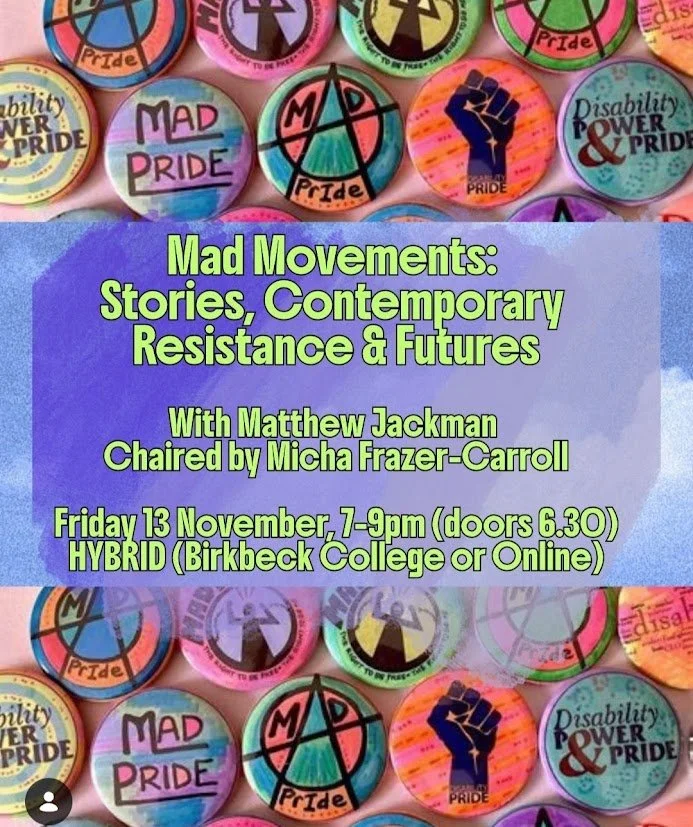
On Friday 13 November 2026, I attended Mad Movements: Stories, Contemporary Resistance & Futures, an event at Birkbeck College in London, hosted by the Mental Health and Social Justice Network.
The event featured Matthew Jackman (they/them), an activist-researcher exploring international Mad movements, and was chaired by Micha Frazer-Carroll (she/her), writer, campaigner and author of Mad World: The Politics of Mental Health.
Matthew has interviewed 42 activists from across the world as part of their PhD research, speaking with people who identify as Mad, psychiatric survivors, consumers, service users, members of Mad Pride movements and people with psychosocial disabilities.
The evening explored the histories of Mad movements, the challenges they face today and what their futures might look like.
I went along because I'm increasingly interested in how lived experience can shape conversations about mental health, and how people who have experienced psychiatric care can become active participants in improving it.
I came away with pages of notes, new connections and plenty to think about.
But one idea stood out to me more than anything else:
Recovery is often considered a solitary journey. But it doesn't have to be.
Finding community in experiences that can feel isolating
When I experienced my first episode of psychosis in 2020, I couldn't have imagined how much my understanding of mental health, identity and recovery would change in the years that followed.
There are aspects of experiencing psychosis and being sectioned that can feel profoundly isolating. Even when you're surrounded by people who love you, it can be difficult to explain what you've been through, particularly when you're still trying to understand it yourself.
Recovery can sometimes feel like something you're expected to work through individually. You're given treatment, appointments, medication, perhaps some psychological support, and then you're left to find your way forward.
Of course, everybody's recovery looks different. But one thing I've come to appreciate is just how important connection can be.
During the event, Matthew explored the question of whether there is a single, coherent Mad movement, given the diversity of identities, experiences, perspectives and approaches across the world.
One question from my notes particularly struck me:
"Am I alone?"
And alongside it were some of the things that help bring people together: relationships, regional collectives, shared survivor histories and community.
It made me think about how easily we can feel isolated by our experiences, even when there are people all over the world asking similar questions, navigating similar challenges and looking for somewhere they belong.
Sometimes, finding those people can change everything.
From sufferer to knower
Another phrase I wrote down was:
"From sufferer to knower."
I love this idea.
So often, conversations about mental health position people who have experienced mental illness as patients, recipients of care or subjects of research.
But what about the knowledge we gain from living through these experiences?
What about the insights that come from navigating psychiatric services, rebuilding our lives after hospitalisation, recognising our own warning signs or discovering what actually helps us feel well?
These experiences give us knowledge that cannot always be found in textbooks or clinical research.
That doesn't mean professional expertise isn't valuable. It absolutely is. But lived experience is valuable too, and I believe the two can complement each other.
One question raised during the evening was:
How is lived experience valued?
It's something I've been thinking about a great deal as I develop Life After Being Sectioned (LABS), and particularly as I explore how my Recovery Workbook might be used to support people after mental health crises.
The workbook grew from my own experiences and from recognising how difficult it can be to make sense of life after a crisis.
I'm not a clinician, and I don't claim to have all the answers. But I do have lived experience, and I believe there is value in transforming what I've learned into something practical that might help someone else.
To me, that's part of what moving from sufferer to knower can look like.
Who gets to define madness?
The evening also explored alternative ways of understanding madness beyond conventional psychiatric frameworks.
One idea discussed was understanding madness as a constellation of experiences rather than simply a diagnosis, recognising the multiplicity of ways people make sense of their own lives.
This challenged me to think more deeply about language.
Some people identify strongly with psychiatric diagnoses. Others reject medical interpretations of their experiences. Some embrace the word Mad as an identity, a political statement or an act of reclamation.
Others don't identify with it at all.
And that's okay.
I have a diagnosis of bipolar disorder, and having that diagnosis has helped me understand experiences that previously felt confusing and frightening.
But I also recognise that not everyone experiences diagnosis in the same way, and not everyone feels that psychiatric language adequately describes what they've been through.
The discussion introduced the concept of sanism, which refers to prejudice, discrimination and oppression directed towards people who are perceived as mad or mentally ill.
We also considered how language and institutional power can shape people's experiences, including the uncomfortable distinction between being treated as a patient and feeling like a prisoner.
For someone who has experienced involuntary psychiatric hospitalisation, that distinction raises some important questions about autonomy, dignity and how people are treated during periods of extreme vulnerability.
One of my biggest reflections was that we don't all have to understand our experiences in the same way to recognise the importance of treating one another with dignity and respect.
There should be space for different perspectives, different identities and different understandings of what recovery means.
What does successful recovery actually look like?
Another interesting theme was how we measure success in mental health research and recovery.
My notes include a reference to climbing a mountain, which got me thinking about the way recovery is often described as a journey towards a particular destination.
But what if there isn't one destination?
What if recovery isn't about reaching the summit, returning to who you were before or meeting somebody else's definition of being well?
What if success looks like reconnecting with a friend, finding something that brings you joy, recognising an early warning sign or managing to get through a particularly difficult day?
I think quality of life deserves a much bigger place in conversations about mental health outcomes.
Recovery isn't always linear, and progress isn't always easy to measure.
For me, recovery hasn't meant returning to the person I was before psychosis and my bipolar diagnosis.
It's involved getting to know myself again, understanding my needs, developing new routines, building confidence and discovering what a meaningful life looks like now.
Some of the things I'm proudest of probably wouldn't appear on a conventional clinical outcome measure.
But that doesn't make them any less significant.
We exist. We resist. Context is everything.
Towards the end of my notes, I wrote down three ideas Matthew mentioned:
1. We exist.
2. We resist.
3. Context is everything.
These felt like a powerful summary of some of the themes running through the evening.
We exist speaks to visibility, recognition and the importance of ensuring that people with lived experience are heard.
We resist speaks to challenging stigma, discrimination, harmful stereotypes and systems that don't always treat people with the dignity they deserve.
And context is everything reminds me that language, identity and experience are deeply personal. What feels empowering to one person may feel uncomfortable or alienating to another.
My final note of the evening was written in particularly large letters:
MADNESS ≠ VIOLENCE!
It's such an important reminder that experiencing madness or mental illness does not automatically make someone violent or dangerous.
We still have a long way to go in challenging the stereotypes that surround mental illness, particularly psychosis.
And I think those of us who feel comfortable sharing our experiences can play a meaningful role in helping to change those narratives.
Why this matters to Life After Being Sectioned
I started Life After Being Sectioned because I wanted to create something that I wish had existed when I first came home from psychiatric hospital.
Somewhere that acknowledged how strange, overwhelming and uncertain life after a mental health crisis can feel.
Somewhere that offered practical resources, honest reflections and reassurance that recovery doesn't have to follow a particular timeline.
And somewhere that might help people feel a little less alone.
Listening to Matthew's reflections on Mad movements made me think about how LABS fits into a much wider landscape of people using their experiences to support others, challenge assumptions and create change.
I'm particularly interested in the idea of preserving and sharing lived-experience knowledge.
Every person's story is different, but there can be enormous value in hearing how someone else made sense of their experiences, navigated difficult moments or gradually rebuilt their life.
We don't have to agree on everything. We don't have to share the same diagnosis, identity or understanding of madness.
Sometimes, simply knowing that another person has been through something difficult and found a way forward can offer hope.
And sometimes, being part of a community means having the freedom to say, "This happened to me," without having to explain or justify every part of your experience.
Recovery doesn't have to happen alone
I left the event feeling inspired, curious and grateful to have been part of the conversation.
There's so much more for me to learn about Mad movements, psychiatric survivor activism and the different ways people around the world are organising for change.
But the idea I keep coming back to is that recovery doesn't have to be a solitary journey.
I know how much the people around me have contributed to my own recovery. Friends, family, professionals, people with shared experiences and unexpected connections have all played their part.
Some have helped me through the hardest moments of my life. Others have helped me rediscover joy, creativity, confidence and a sense of possibility.
And now, through LABS, I hope I can contribute something meaningful to somebody else's journey too.
Not because I have all the answers.
But because I've learned that sometimes, sharing what we've been through can help someone else feel understood.
We each have our own experiences. We each find our own way forward. But we don't have to do it all by ourselves.
And perhaps that's one of the most powerful things a community can offer.
If you're navigating life after a mental health crisis, you're welcome to explore Life After Being Sectioned and join The Recovery Room, a free members' space where I share practical resources, reflections and support for life after crisis.
Thank you to Matthew Jackman, Micha Frazer-Carroll and the Mental Health and Social Justice Network for creating space for such an interesting and thought-provoking conversation.